DIY vs Pro Sprinkler Installation
The Honest Answer Up Front
Yes, some homeowners can install their own sprinkler system — and for a certain kind of yard, it is a reasonable weekend-warrior project. We would rather tell you when DIY genuinely makes sense than pretend it never does. DIY is viable when: your yard is small and flat (2–3 zones), you are comfortable running poly pipe with a rented pipe puller or trencher, your water source and pressure are straightforward, and you are willing to handle the permit and backflow requirements below. If that describes your project, the DIY math can work. Where DIY goes wrong is almost never the digging — it is the design and the rules.
What the Box Stores Don't Tell You
Four requirements apply to every irrigation installation in Minnesota, DIY or professional: • Backflow prevention with a permit and testing. Connecting irrigation to your home supply requires a code-compliant backflow assembly. The Minnesota Department of Labor and Industry confirms the 2020 Minnesota Plumbing Code requires all testable devices to be tested at installation and at least annually thereafter by a certified tester. Most cities also require a plumbing permit for the connection. • The rain sensor statute. Minnesota Statute 103G.298 requires moisture-interruption technology on every automatically operated system — including yours. • Utility locates. Minnesota law requires calling Gopher State One Call before any digging. Hitting a buried gas or fiber line turns a $1,500 project into a very bad month. • Head spacing math. Head-to-head coverage (each head throwing to its neighbor) is what prevents the striped-lawn look. Getting precipitation rates matched within a zone is design work, not shopping work.
The Real Cost Comparison
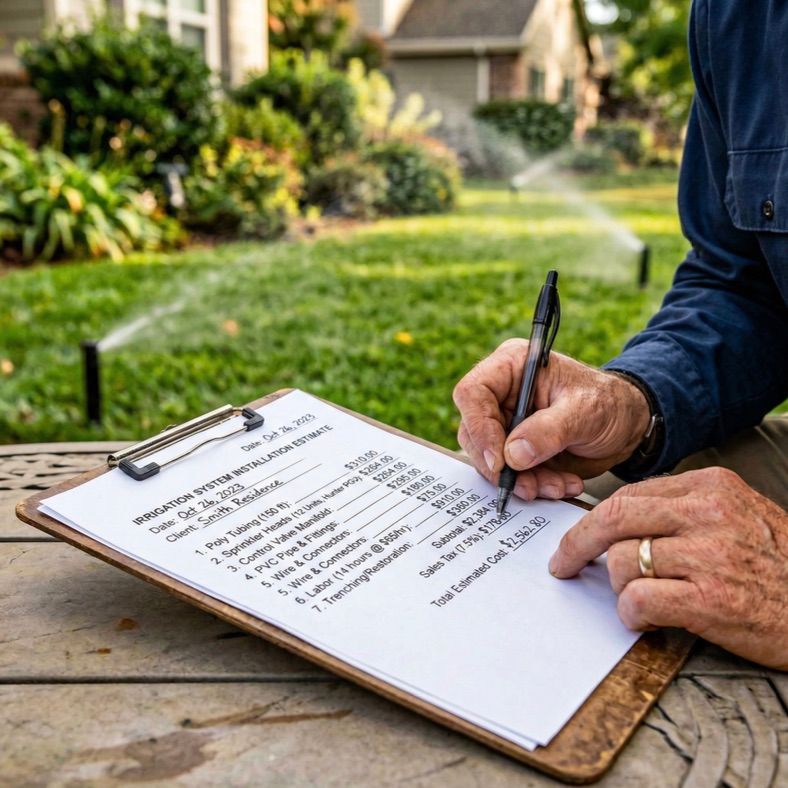
Using our actual published install pricing — not inflated strawman numbers:
| Path | Typical Cost | What You Get |
|---|---|---|
| DIY materials (4–6 zones) | $800–$1,500 | Pipe, heads, valves, controller, backflow device — your labor, your design |
| DIY + tool rental | +$150–$400 | Trencher or pipe puller, typically 1–2 weekend days |
| DIY hidden extras | +$200–$500 | Plumbing permit, backflow install by licensed plumber, certified first test |
| Grin's basic install (4–6 zones) | $2,500–$3,500 | Design, installation, permit handling, compliant backflow + sensor |
| Grin's standard install (6–10 zones) | $3,500–$5,000 | Full property coverage with matched precipitation zones |
| Every professional install includes | — | 2-year parts warranty, 1-year labor warranty, free first-year winterization |
When DIY Makes Sense — and When It Does Not
Choose DIY if: the yard is small and flat, you enjoy this kind of project, you will honestly follow through on the permit, backflow test, rain sensor, and locates, and your time is genuinely free. Choose professional installation if: the yard has slopes, mature trees, or more than ~6 zones; you have low water pressure or an unusual supply; you want the warranty to be someone else's problem; or the gap between DIY-with-extras and a professional basic install has shrunk to a few hundred dollars — which, as the table shows, it often does. Either way, plan for the real total, not the pipe-and-heads number on the store shelf.
A Middle Path: DIY-Assist
Some homeowners hire us for the parts that carry risk — the water supply connection, backflow assembly, and zone design — then trench and lay pipe themselves to a plan we draw. If you are set on doing the labor but want the design and compliance handled, ask about it during a free consultation. And if a previous DIY install is underperforming, our repair crew diagnoses and fixes DIY systems every week, no judgment attached.
Want real numbers for your yard? Get a free no-pressure quote.
Get Your Free Quote